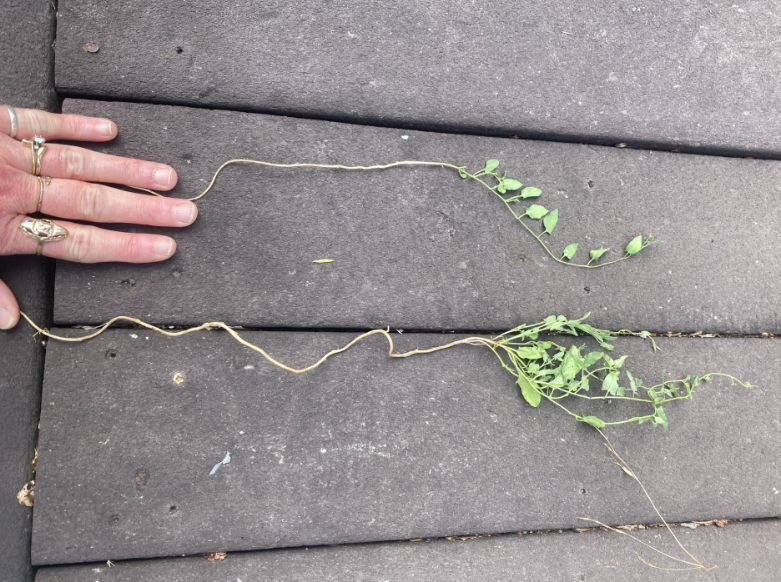
Most of the time, I love weeding. It gives me a reason to get outside in the fresh air and move my body a little more. If you google benefits of putting your hands in the soil, you might be surprised to learn that getting your hands dirty can improve your mood, digestion, and stress levels. Gardening also gives me the delight in seeing the progression of growth in my flowers, discovering pollinators enjoying my coneflowers and milkweed, tasting the mulberries ripely dangling on the tree, and taking in the beauty of the tiger lilies blooming in my yard.
Weeding is deeply satisfying for me. Maybe it’s knowing that by doing so, I give the good plants more room to flourish. I have long been an agent of personification, and I imagine my flowers stretch their legs, wiggle their toes, and sigh in relief when clingy “friends” leave. Ragweed, crabgrass, mallow, nightshade, and bedstraw are just a few annoyances I pull out of my gardens. However, none compares to one trouble I have discovered. It is my nemesis, and its name is Bindweed.
Penn State Extension’s description of this perennial includes such adjectives as noxious, invasive, and persistent. Many gardeners have cursed its existence, and farmers have found this nuisance to reduce crop productivity by 50% due to its competition for moisture. This pest’s seeds can remain viable for 20-50 years in an underground seedbank, waiting to be tilled so air, light, and moisture can bring them to life. One of its common names is Devil’s Guts, and I have camaraderie with whoever christened this.
Bindweed is barely noticeable at first. It pops up right next to the beginnings of any other plant in your garden. You may not even notice it if you haven’t learned to recognize the leaves. Its roots cozy up with the good plants’ roots until there is no personal space to be found. The roots dive long (10-18 feet horizontally) and deep (20 feet down). These facts don’t stop me from trying to dismantle bindweeds’ hold on my garden. Occasionally, I will congratulate myself for gently tugging out 6-10 inches of root, but it is a shallow celebration. No matter how much I succeed in removing these weeds, I can never pull the roots out completely intact. Not only that, but as bindweed grows, it weaves itself around nearby stems until it so intertwined the neighboring plant will choke to death without help from the gardener. There is no way to remove this menace from my coneflowers without breaking it off from its base and leaving it wrapped around the stem. Then there remains evidence of its former chokehold unless I were to spend additional hours unwinding each one. If I am tempted to just yank it and hope it will magically disentangle itself, I end up uprooting my flowers along with it (yes, I have done this more than once–I am a slow and stubborn learner at times). Yet if I were to throw my hands up in surrender, my entire yard would be covered with this weed instead of with the beauty and nourishment my coneflowers, sunflowers, milkweed, and lavender provide for butterflies, bees, and birds.
It is while gardening that I find truths of nature, life, and God’s word illustrated.
Bindweed probably is not the problem plant Jesus talked about in the parables from Matthew 13, but this nemesis of mine surely has helped me better understand the truths Jesus was conveying. It also helps me understand why I have a lifelong struggle with certain things. I am coming to learn I cannot uproot all that is wrong with the world or in me on my own. I need the grace and righteousness Jesus provides. I so long for the day when this deep root of going my own way instead of God’s way is finally and completely uprooted–not only in my life but in the entire world. What a beautiful and glorious day that will be!
Until then, I am called to not give up doing my part in uprooting what I can. Without this now-and-not-yet-work of tackling my area of creation to rid what I can of what is wrong, far less beauty and goodness will be evident.
I hope you will join me in weeding what we can.
“Let us not become weary in doing good, for at the proper time we will reap a harvest if we do not give up.” Galatians 6:9
